


Bookkeeping for Tradies: How to Do It Yourself and Save Money
In this guide, we'll walk you through the bookkeeping basics every Aussie tradie should know, how to avoid common mistakes, and how to make managing your business finances a whole lot easier.
Article contents
− +- Introduction
- Why bookkeeping matters for Australian tradies
- How to do your own bookkeeping as a tradie
- Common bookkeeping mistakes tradies make
- Do tradies really need a bookkeeper?
- How much does bookkeeping for tradies cost?
- Bookkeeping software vs hiring a bookkeeper
- Stay on top of bookkeeping for your trade business in minutes
Running your own trade business means wearing a lot of hats.
One minute you're quoting a job, the next you're chasing an unpaid invoice, buying materials, or trying to figure out how much to put aside for tax.
And somewhere in between all that, you've got to keep your books in order.
The good news?
Bookkeeping for tradies doesn't have to be complicated, and you don't necessarily need to pay a bookkeeper to do it for you.
With the right tools and a few good habits, you can keep track of your income, expenses, and tax obligations yourself – without having to become a bookkeeping expert.
Why bookkeeping matters for Australian tradies
When you're busy quoting jobs, buying materials, and keeping customers happy, bookkeeping probably isn't at the top of your list.
But keeping your finances organised is an important part of running a successful trade business.
Good bookkeeping helps you:
Keep track of your cash flow. Knowing how much money is coming in and going out helps you plan ahead, cover your expenses, and avoid running short between jobs.
Stay on top of unpaid invoices. It's easy to lose track of who owes you money when you're juggling several jobs. Having a good invoicing system makes it easier to track payments and follow up with customers.
Understand your business expenses. Tools, fuel, materials, insurance, and other costs add up. Keeping accurate records helps you see how much you're spending and whether you're charging enough for your work.
Make tax time less stressful. Good records make it easier to claim eligible business tax deductions and prepare your BAS if you're registered for GST.
Make smarter business decisions. Whether you're thinking about buying a new ute or taking on a bigger job, knowing your numbers helps you work out what you can afford.
You also don't need to be an accounting expert to keep your books in order.
A few good habits and the right tools can make bookkeeping much easier, even if you'd rather be on the tools than sitting behind a desk.
How to do your own bookkeeping as a tradie
You don't need an accounting degree to manage your own books.
If you're a sole trader, most of your bookkeeping comes down to keeping good records, tracking what you earn and spend, and setting money aside for tax.
Here's how to get started.
1. Keep your business and personal finances separate
Start by opening a dedicated bank account for your trade business. It's not legally required for sole traders, but it makes bookkeeping much easier.
Use this account to receive customer payments and pay for materials, tools, fuel, and other business expenses. That way, you won't have to sort through personal purchases every time you check your finances.
If you're unsure where to start, we've put together a guide to business bank accounts for sole traders.
2. Record every payment you receive
Every time a customer pays you, record the amount, date, and what the payment was for.
This includes bank transfers, card payments, and cash jobs. Even if someone pays you $100 in cash for a quick repair, that income still needs to go into your records.
Get into the habit of sending invoices as soon as you finish a job. Include clear payment terms and check your outstanding invoices regularly so you know who still owes you money.
3. Track your expenses as they happen
Don't leave a pile of receipts in your ute and promise yourself you'll sort them out later.
Whenever you buy something for work, record the purchase and keep the receipt. Common expenses for tradies include:
Tools and equipment
Building materials and supplies
Fuel and vehicle expenses
Insurance and licences
Work clothing and protective equipment
You can use a spreadsheet, but expense tracking software makes it easier to keep everything organised.
Rounded, for example, automatically creates expenses for you by simply scanning your receipts.
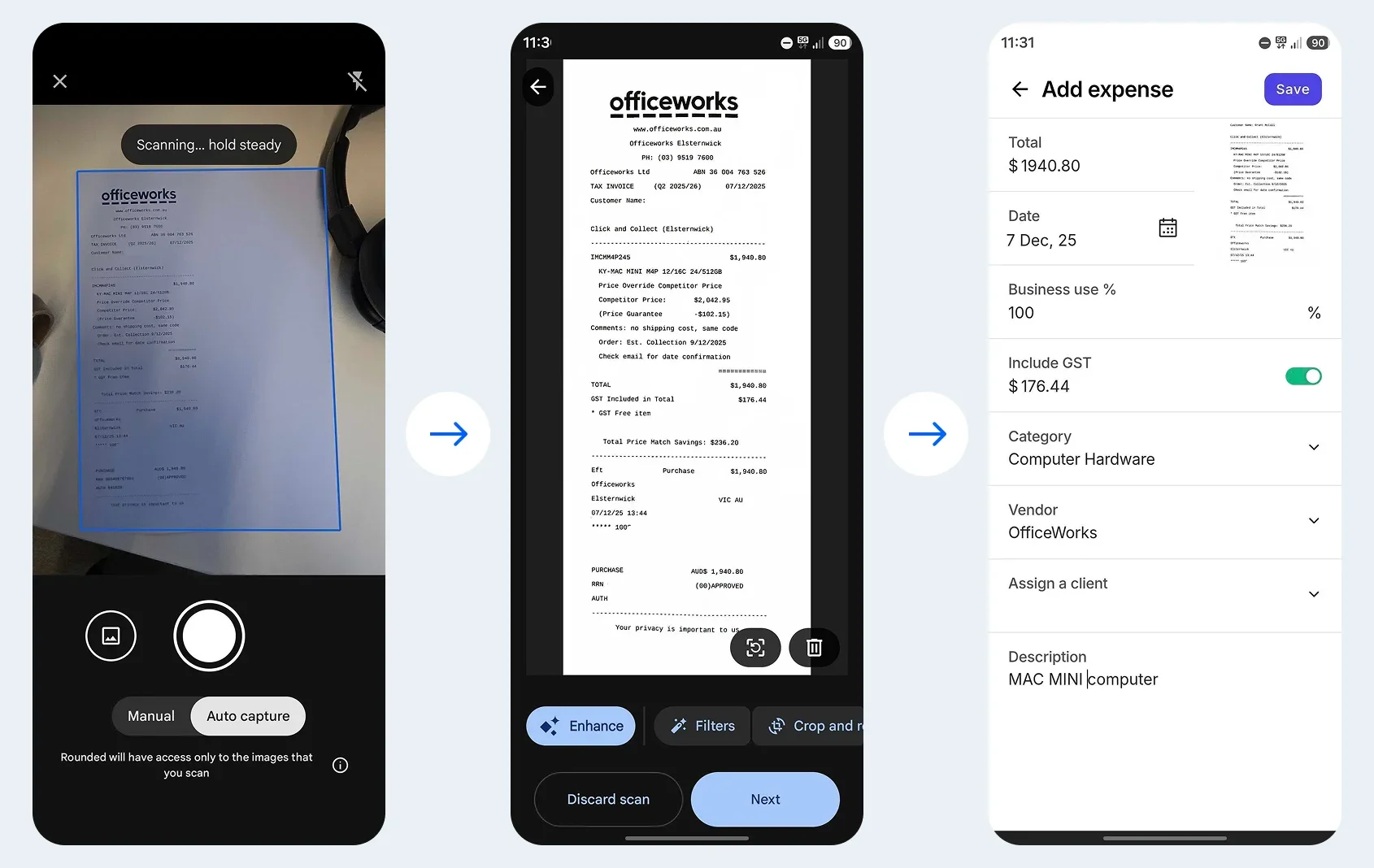
Make sure you also record which expenses are partly personal, such as a phone you use for both work and home.
4. Set money aside for tax and GST
One of the biggest mistakes you can make as a sole trader is treating every dollar that comes into your account as money you can spend.
Open a separate savings account for tax and transfer a portion of each customer payment into it.
Your accountant can help you work out an appropriate percentage based on your expected earnings, or you can use a tool like Rounded to track how much to set aside as you earn.
If your GST turnover reaches $75,000 or more, you'll generally need to register for GST.
Once registered, you'll also need to account for GST and lodge Business Activity Statements (BAS).
5. Set aside 15 minutes each week for bookkeeping
Pick a day that works for you, whether it's Friday afternoon after your last job or Sunday evening before the new week starts.
Use those 15 minutes to:
Check that all customer payments have been recorded.
Add any missing expenses and receipts.
Follow up on overdue invoices.
Compare your records with your bank transactions.
Check how much money you've put aside for tax.
Doing a little bookkeeping every week is much easier than trying to sort out six months of transactions when tax time rolls around.
Common bookkeeping mistakes tradies make
Even with the best intentions, it's easy to let your bookkeeping slip when you're busy on the tools. Here are some common mistakes to watch out for and how to avoid them.
1. Mixing personal and business expenses
Buying groceries and building materials with the same bank card makes it harder to work out which purchases belong to your business.
How to avoid it:
Use a separate account and card for work purchases. If you accidentally use your business account for something personal, record it correctly rather than treating it as a business expense.
2. Forgetting to record small expenses
A $15 parking fee here and a $30 purchase at Bunnings there might not seem important, but these costs add up over a year.
How to avoid it:
Record expenses as soon as you make them. Take a photo of the receipt before leaving the shop and store it with the transaction.
3. Waiting until tax time to organise everything
Trying to remember what you spent money on eight months ago isn't much fun. It's also easy to miss expenses or make mistakes when you're rushing to get everything ready for your accountant.
How to avoid it:
Check your records weekly and do a more detailed review at the end of each month.
Our sole trader tax guide can help you see what records you'll need when June rolls around.
4. Not following up on unpaid invoices
Finishing a job doesn't mean the money is already in your account. If you don't keep track of outstanding invoices, you could end up struggling to cover materials for your next project.
How to avoid it:
Set clear payment terms before starting work, send invoices promptly, and review overdue payments every week.
Apps like Rounded also allow you to set automatic reminders so unpaid invoices don't slip through the cracks.
5. Claiming expenses that aren't fully deductible
Not everything you buy can be claimed as a business expense. For example, you generally can't claim the full cost of your ute if you also use it for personal trips.
How to avoid it:
Keep records that show how much you use an item or vehicle for business purposes.
If you're unsure whether something is deductible, check with a registered tax agent before claiming it.
6. Not checking whether you're actually making a profit
You might have $10,000 coming in from jobs this month, but that doesn't mean you've made $10,000 in profit.
Materials, fuel, insurance, equipment, and other expenses all need to come out of that amount.
How to avoid it:
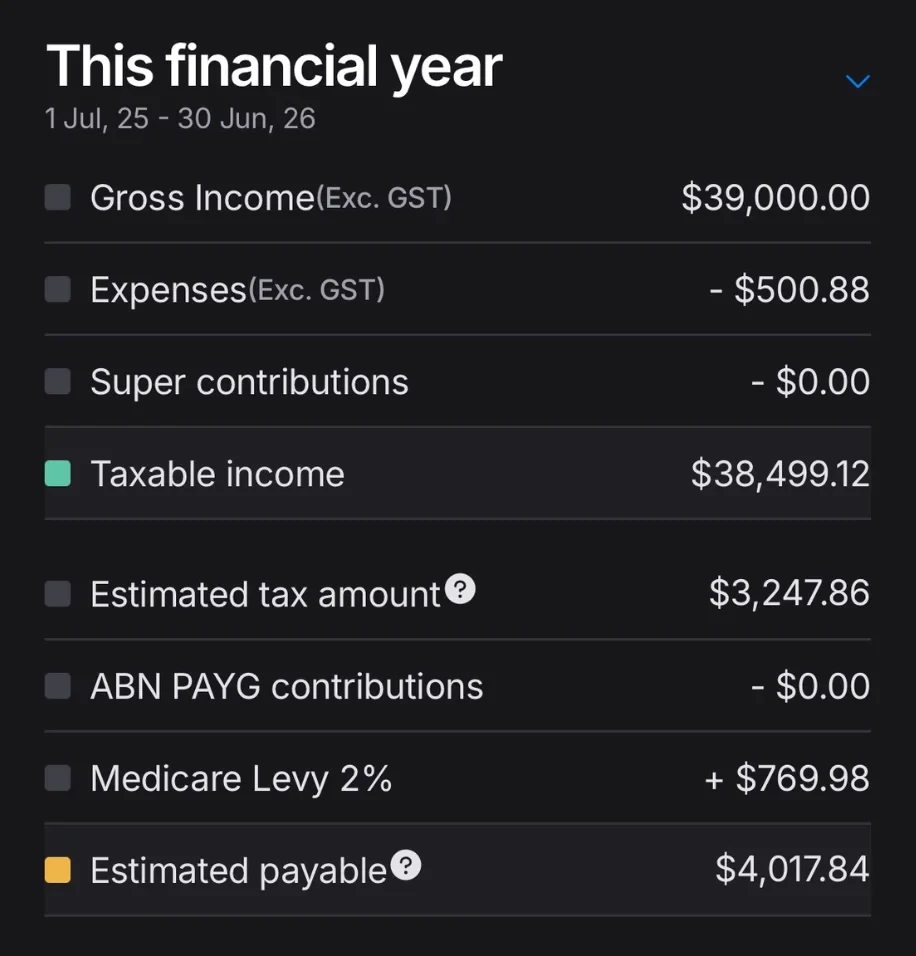
At the end of each month, compare your income against your business expenses.
Look at which costs are rising and whether you're charging enough to cover them. This will help you price future jobs more accurately.
Rounded users can see this instantly on their dashboard:

Do tradies really need a bookkeeper?
If you're a sole trader working for yourself, you can probably handle most of your bookkeeping without hiring someone.
For example, if you're a plumber who sends a few invoices each week, buys materials, and keeps track of business expenses, there's no reason you can't manage those records yourself.
You just need a reliable system and a little time each week.
However, hiring a bookkeeper might make sense if:
You're dealing with hundreds of transactions every month.
You're consistently falling behind on invoices and expense records.
Your business finances are getting more complicated.
You have employees and need help managing payroll.
You'd rather pay someone to handle the paperwork.
It's also important to understand the difference between an accountant and a bookkeeper.
A bookkeeper generally takes care of everyday financial records, while an accountant can help with tax returns, financial advice, and planning.
You might find that doing your own bookkeeping and checking in with an accountant at tax time gives you all the support you need.
How much does bookkeeping for tradies cost?
Hiring a bookkeeper in Australia typically costs between $40 and $120 per hour, depending on their experience, location, and the work involved.
The Institute of Certified Bookkeepers reported an average hourly rate of $83.20 in its 2025 survey.
For a sole trader who needs four hours of bookkeeping each month, that's roughly $330 per month, or almost $4,000 a year at the average hourly rate.
Your actual costs will depend on how much help you need. Some bookkeepers charge by the hour, while others offer fixed monthly packages.
You may also pay extra for services such as:
BAS preparation and lodgement: Getting your GST records ready and lodging your BAS through a registered BAS or tax agent.
Payroll: Processing employee wages, superannuation, and other payroll obligations.
Catch up bookkeeping: Sorting through months of missing transactions, receipts, and invoices.
These services aren't necessarily included in a standard bookkeeping package, so always ask what's covered before agreeing to a price.
If you're a sole trader with relatively simple finances, paying hundreds of dollars each month for bookkeeping might be unnecessary.
Accounting software for sole traders can help you handle everyday tasks yourself at a fraction of the cost.
That doesn't mean you should avoid professional advice altogether. An accountant can still help you get your taxes right and answer questions about deductions or GST.
Bookkeeping software vs hiring a bookkeeper
Both options can help you keep your business finances organised, but they work quite differently.
Here's how they compare:
Bookkeeping software | Hiring a bookkeeper | |
Typical cost | Around $20 to $60 per month for basic sole trader software | $40 to $120 per hour |
Who does the work? | You manage your records using the software | A professional manages agreed tasks |
Invoicing | Create and send invoices yourself | May prepare and send invoices for you |
Expense tracking | Record and categorise expenses | Records and reconciles expenses |
Bank transactions | Can import transactions automatically | Reviews and reconciles transactions |
BAS preparation | Helps organise GST records and figures | A registered BAS or tax agent can prepare and lodge BAS for a fee |
Financial advice | Limited to reports and financial information | Depends on the bookkeeper's qualifications and services |
Best suited for | Sole traders with relatively simple finances | Businesses with complicated records or limited capacity to manage bookkeeping |
When bookkeeping software may make more sense
If you're running your trade business on your own, bookkeeping software will often be enough to manage your everyday financial records.
Instead of paying someone to enter transactions and organise receipts, you can use software to:
Create quotes and send invoices after completing jobs.
Track payments and follow up on overdue invoices.
Record expenses and keep digital copies of receipts.
Import bank transactions to reduce data entry.
Monitor your income and expenses throughout the year.
Organise your financial records for tax time.
You can also check your finances whenever you need to, whether you're at home or between jobs.
The main thing to remember is that software doesn't take responsibility for your bookkeeping.
You'll still need to check transactions, keep accurate records, and make sure everything is up to date.
When hiring a bookkeeper makes more sense
A bookkeeper can be helpful if your business has grown beyond what you're comfortable managing yourself.
For example, if you're running several jobs at once, dealing with a large number of suppliers, or struggling to keep your records accurate, having someone take care of the bookkeeping may be money well spent.
A professional can also help identify errors, reconcile accounts, and get your records back in order if you've fallen behind.
Can you use both?
Absolutely. You don't have to choose one or the other.
Many tradies can manage everyday bookkeeping with software and bring in a professional when they need extra help.
You might handle your own invoices, expenses, and payments throughout the year, then work with an accountant to review your records, prepare your tax return, or deal with more complicated tax questions.
Or you may choose to handle your own day-to-day bookkeeping, and bring in a bookkeeper once a month to make sure your records are in order.
This approach gives you control over your finances without paying someone to handle every small transaction.
Stay on top of bookkeeping for your trade business in minutes
You've got enough to worry about when you're running a business. Keeping track of invoices, chasing payments, and organising receipts shouldn't take up your evenings or weekends.
That's where Rounded comes in.
Built to be used by Australian sole traders, Rounded gives you everything you need to manage your everyday bookkeeping in one place.
With Rounded, you can:
Create and send professional invoices as soon as a job is finished.
Track business expenses and keep your receipts organised for tax time.
Connect your bank account to import transactions and keep an eye on your finances.
Track GST and prepare for BAS without sorting through piles of paperwork.
See how your business is performing with a clear overview of your income and expenses.
You don't need to be a bookkeeping expert to get started, and you don't have to spend hundreds of dollars every month just so you can stay organised.
“I'm saving hours and hours with quoting and on the admin side of things.”
– Lachlan Brookes, Carpenter at Brookes Handcrafted Carpentry Services
Try Rounded free for 14 days and see for yourself. No credit card needed.
–
Cover photo by Annie Spratt on Unsplash
Contents
Join newsletter
ABOUT ROUNDED
Invoicing and accounting software for sole traders. Get paid faster and relax at tax time.